Safe Air Fresheners: 7 Easy Tips for Healthy Indoor Air
Walk down the cleaning aisle of any supermarket and you’ll find shelves full of sprays, plug-ins, gels and candles promising “fresh linen” or “ocean breeze.” What almost none of them tell you is what’s actually inside the bottle — which is exactly why shoppers are starting to hunt for safe air fresheners instead of grabbing whatever smells nice. The truth is that a product can make your kitchen smell like a lemon grove while quietly adding chemicals to the air you breathe all day. That doesn’t mean you have to live in a scent-free house. It means learning to read labels, understanding a few key ingredients, and knowing when an open window does a better job than an aerosol can. Here are seven practical tips to help you freshen your home without trading away your indoor air quality.
Why Your Air Freshener Choice Matters More Than You Think
Indoor air is often more polluted than the air outside, partly because modern homes are sealed tightly for energy efficiency. Cooking fumes, cleaning products, furniture off-gassing and scented products all mix together in a space with limited ventilation. The U.S. Environmental Protection Agency’s indoor air quality resources point to household products as one common source of indoor pollutants. Conventional fresheners don’t remove odor molecules — most simply cover them with a stronger smell, adding compounds to the mix rather than subtracting them. For a healthy adult, a quick spray now and then probably isn’t a crisis. But for children, older adults, pregnant people and anyone with asthma, daily exposure can matter. That’s the case for choosing safe air fresheners the same way you’d choose food: carefully, and with the ingredient list in hand. If you want to dig deeper, our guide on eco friendly pest control: 7 proven ways to keep home safe covers this in more detail.
There’s also an environmental side that rarely makes the marketing copy. Aerosol cans, plastic plug-in refills and single-use scent pods create packaging waste that’s hard to recycle. Some propellants and solvents contribute to outdoor smog once they escape into the atmosphere. Synthetic musks used in many fragrance blends have been detected in waterways, and they break down slowly. So the question isn’t only “is this safe to breathe?” but also “where does this end up when I’m done with it?” The good news: the answers usually point in the same direction. Products with simpler ingredients, refillable or compostable formats, and less packaging tend to be better on both counts. Once you start looking for genuinely safe air fresheners, the greener option often turns out to be the healthier one too.
7 Tips for Choosing Safe Air Fresheners
1. Insist on Full Fragrance Disclosure
The single word “fragrance” or “parfum” on a label can legally stand in for dozens of individual chemicals, because fragrance blends are treated as trade secrets in many markets. That’s a problem if you’re trying to avoid a specific irritant or allergen. Brands that genuinely make safe air fresheners tend to list every scent component, or at least publish a full ingredient breakdown on their website. Look for phrases like “100% of ingredients disclosed” and then actually check the list. If a company won’t tell you what’s in the bottle, treat that as useful information. Transparency costs nothing when you have nothing to hide. As a quick test, search the brand name plus “ingredients” — if the only result is marketing language about “natural essences,” keep shopping.
2. Learn the Ingredients Worth Skipping
You don’t need a chemistry degree, just a short mental blacklist. The main categories to watch are VOCs and phthalates, along with a handful of preservatives and propellants. Volatile organic compounds evaporate at room temperature, which is exactly how a freshener spreads scent through a room — and also how it enters your lungs. Phthalates are sometimes used to make fragrance last longer, and several have been restricted in consumer goods in various countries. Other names worth noting: formaldehyde-releasing preservatives, benzene, toluene, limonene and styrene. Limonene smells like citrus and isn’t dangerous in itself, but it can react with indoor ozone to form secondary pollutants. Scanning for these terms takes ten seconds and rules out a surprising number of products marketed as safe air fresheners without much evidence behind the claim. This connects closely with another common issue — see Kid- and Pet-Safe House Cleaning: Non-Toxic Products for Floors, Furniture, and Toys for more on that.
3. Rethink Aerosols and Always-On Plug-Ins
Format matters as much as formula. Aerosol sprays create a fine mist of tiny droplets that stay suspended in the air and travel deep into the lungs — far deeper than a liquid you wipe onto a surface. Plug-in devices create a different issue: they release scent continuously, twenty-four hours a day, often in bedrooms and hallways where you spend the most time. Low-dose but constant exposure is not obviously better than occasional exposure. The American Lung Association’s guidance on indoor air encourages limiting unnecessary sources of indoor pollutants, and a device that never switches off is hard to justify. If you love a particular scent, choose a format you control: a pump spray, a solid wax melt used briefly, or a reed diffuser in a room with good airflow.
4. Check for Independent Certifications
Words like “natural,” “green,” “eco” and “pure” are not regulated in most countries. Anyone can print them. Third-party certifications are harder to fake because they require a company to submit its formula for review. The EPA’s Safer Choice program reviews household product ingredients against health and environmental criteria, and its label is a reasonable starting filter. Other recognized marks include certifications for asthma and allergy friendliness, and European ecolabels for household goods. No single seal guarantees perfection, and some focus on environmental impact rather than respiratory health. Still, a certified product has been looked at by someone other than the marketing department. When you’re comparing two similar bottles at similar prices, the certified one is the better bet.
5. Use Essential Oil Diffusers Thoughtfully
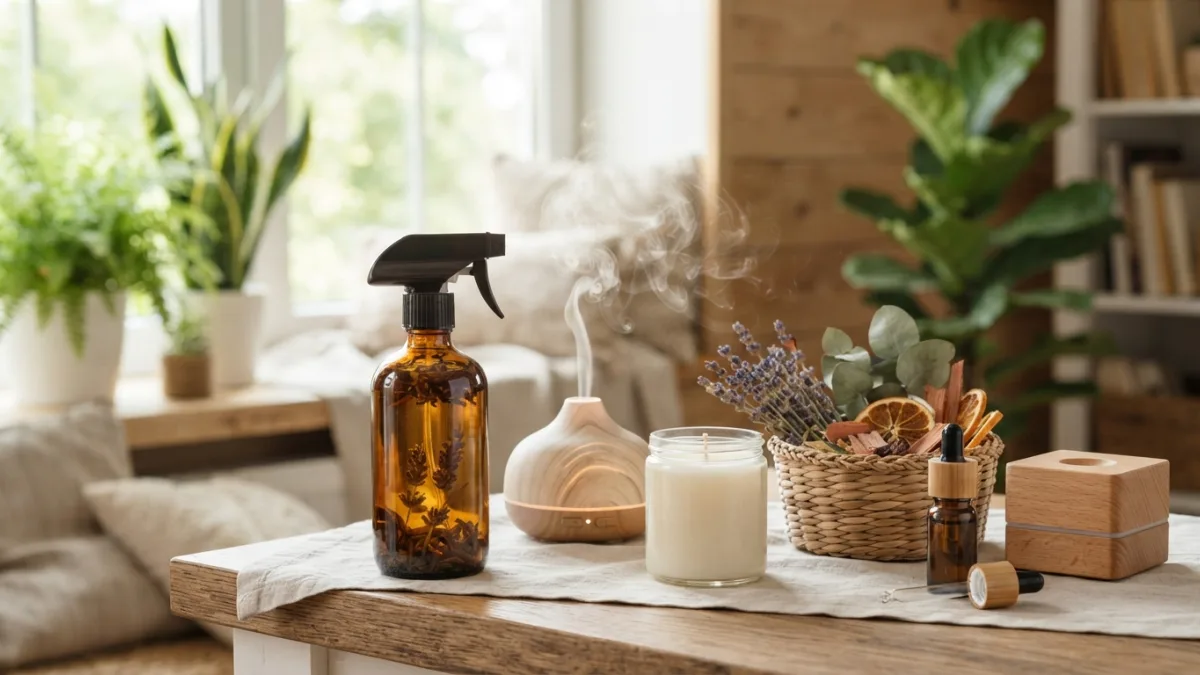
Essential oil diffusers are often presented as the automatic answer, and they can be a good option — but “plant-based” doesn’t mean “harmless to breathe.” Essential oils are concentrated volatile compounds by definition. Tea tree, eucalyptus, peppermint and citrus oils can irritate airways in sensitive people, and several are genuinely risky around cats, dogs and birds, whose bodies process these compounds differently than ours. If you enjoy oils, use them in short sessions rather than all evening, dilute properly, keep the door open, and never run a diffuser in a closed room where a pet can’t leave. Ultrasonic diffusers also need regular cleaning, since standing water grows bacteria and mold that then get sprayed around the room. Used sensibly, they belong on the list of safe air fresheners. Used constantly in a sealed bedroom, less so. You might also find our article on Green Deep-Clean Checklist for Moving In or Out of a Rental Home helpful here.
6. Remove Odors Instead of Masking Them
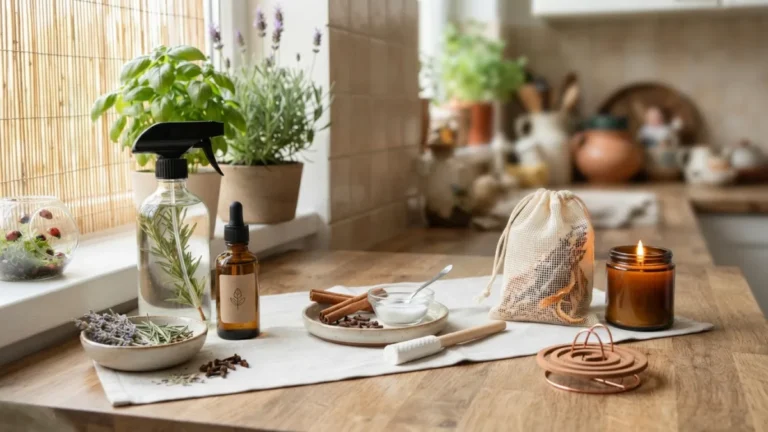
The most effective approach barely counts as air freshening at all. Odor comes from a source — a bin, a damp towel, a litter box, last night’s fish, a fridge that needs cleaning. Deal with the source and the smell disappears without a single added chemical. Fragrance-free alternatives work well as backup: an open box of baking soda in the refrigerator, activated charcoal bags in closets and shoe racks, white vinegar in a bowl to cut cooking smells, or a simmering pot of water with orange peel and cinnamon on the stove. Houseplants won’t purify your air the way some viral posts claim, but they do make a room feel fresher. A HEPA air purifier with a carbon filter handles particles and odors together. These options quietly outperform most bottled products.
7. Consider the Full Life Cycle of the Product
Before buying, ask what happens after the scent runs out. Refillable glass bottles beat disposable plastic ones. Concentrates you mix with tap water at home cut shipping weight and packaging dramatically. Solid formats — wax melts, scented ceramic stones, cardboard car fresheners — avoid propellants entirely. Aerosol cans are technically recyclable in some areas but frequently aren’t accepted, and plug-in refills almost never are. Smaller brands that sell refills by mail can be excellent, though check whether the environmental benefit survives the shipping. A useful rule: if the product is designed to be thrown away every three weeks, it probably isn’t the most sustainable option available. Building a routine around non-toxic home fragrance means thinking about packaging and disposal, not just what comes out of the nozzle.
Comparing Common Home Fragrance Options
No single format is right for every home. Your choice depends on room size, whether you have pets or young children, how sensitive your household is to scent, and how much waste you’re willing to generate. This table gives a quick overview of the trade-offs, so you can narrow things down before you start reading labels in detail. For a related walkthrough, check out Sustainable Swaps for Every Room in Your Home.
| Option | Air Quality Impact | Environmental Impact | Best For |
|---|---|---|---|
| Aerosol sprays | Higher — fine mist, propellants | Poor — cans often not recycled | Rare, short-term use only |
| Plug-in diffusers | Higher — continuous release | Poor — disposable plastic refills | Not generally recommended |
| Reed diffusers | Moderate — depends on oil base | Moderate — glass is reusable | Entryways, bathrooms |
| Essential oil diffusers | Moderate — use in short sessions | Good — low waste, reusable device | Pet-free homes, occasional use |
| Soy or beeswax candles | Moderate — soot and combustion | Good if unpackaged and natural wax | Evening ambience, ventilated rooms |
| Baking soda, charcoal, vinegar | Lowest — no added compounds | Excellent — minimal waste | Fridges, closets, sensitive households |
| HEPA purifier with carbon filter | Lowest — actively removes pollutants | Moderate — filter replacements, energy use | Allergy sufferers, year-round use |
Small Habits That Beat Any Bottle
The cheapest improvement to your indoor air quality costs nothing: open a window. Cross-ventilation for ten or fifteen minutes, twice a day, flushes out accumulated pollutants better than any product on the shelf. Run the extractor fan while cooking and for a few minutes afterward. Use the bathroom fan during and after showers to keep humidity down, since damp air encourages mold, and mold smells bad for a reason. Vacuum with a HEPA filter, wash fabrics that trap odors, and empty the bin before it starts announcing itself. Do these things consistently and you’ll find you need far less fragrance overall. That’s the quiet secret behind the whole conversation about safe air fresheners — the best ones are the ones you barely need to reach for.
Frequently Asked Questions
Are natural or plant-based air fresheners automatically safe?
No. “Natural” isn’t a regulated term, and plant-derived compounds can still irritate lungs or trigger allergies. Essential oils are concentrated and can be harmful to pets, particularly cats and birds. Judge a product by its full disclosed ingredient list and how you use it, not by the word on the front of the package.
What are VOCs, and should I avoid them completely?
Volatile organic compounds evaporate easily at room temperature and can build up indoors. Some come from paint, furniture and cleaning products, not just fragrance. Eliminating them entirely isn’t realistic, but you can reduce unnecessary sources and ventilate regularly. Low-VOC labelling and independent certifications help you compare products meaningfully.
Are scented candles bad for indoor air quality?
Any open flame produces combustion by-products, including soot and fine particles. Candles made from soy or beeswax with cotton wicks generally burn cleaner than heavily fragranced paraffin ones. Trim the wick, burn candles for shorter periods, and keep the room ventilated. Treat them as an occasional pleasure rather than a daily routine.
Do air purifiers replace air fresheners?
They do different jobs, but a purifier is the better tool for actual air quality. A HEPA filter captures particles, and an activated carbon layer absorbs odor molecules and some gases. That’s removal rather than masking. A purifier won’t make your home smell like vanilla, but it will make it smell like nothing — which is usually the goal.
How can I tell if a product is greenwashed?
Check for specifics. Vague claims like “eco-friendly” or “made with essential oils” mean little on their own. Look for a complete ingredient list, a recognized third-party certification, clear information about refills or recycling, and an honest description of what the product does. If the packaging says a lot but the website says nothing, be sceptical.